Universal Design for Learning: designing for every learner from the start
Most lessons are designed for an imagined "average" student, then adjusted for everyone else. reverses that order: plan for the full range of learners from the start.
UDL was developed in the 1990s by CAST, a non-profit education research organisation in the United States. It draws on research into how people learn, and on the principle of universal design in architecture.
UDL applies the same logic to learning. Rather than one way to take in a lesson, one reason to care about it and one way to show understanding, it builds flexibility in from the beginning. It is the framework behind what Sobena calls cognitive diversity by design.
The evidence base is growing. A 2023 systematic review and meta-analysis found positive effects of UDL on learning, though results varied considerably between studies (Almeqdad et al., 2023).
The three principles
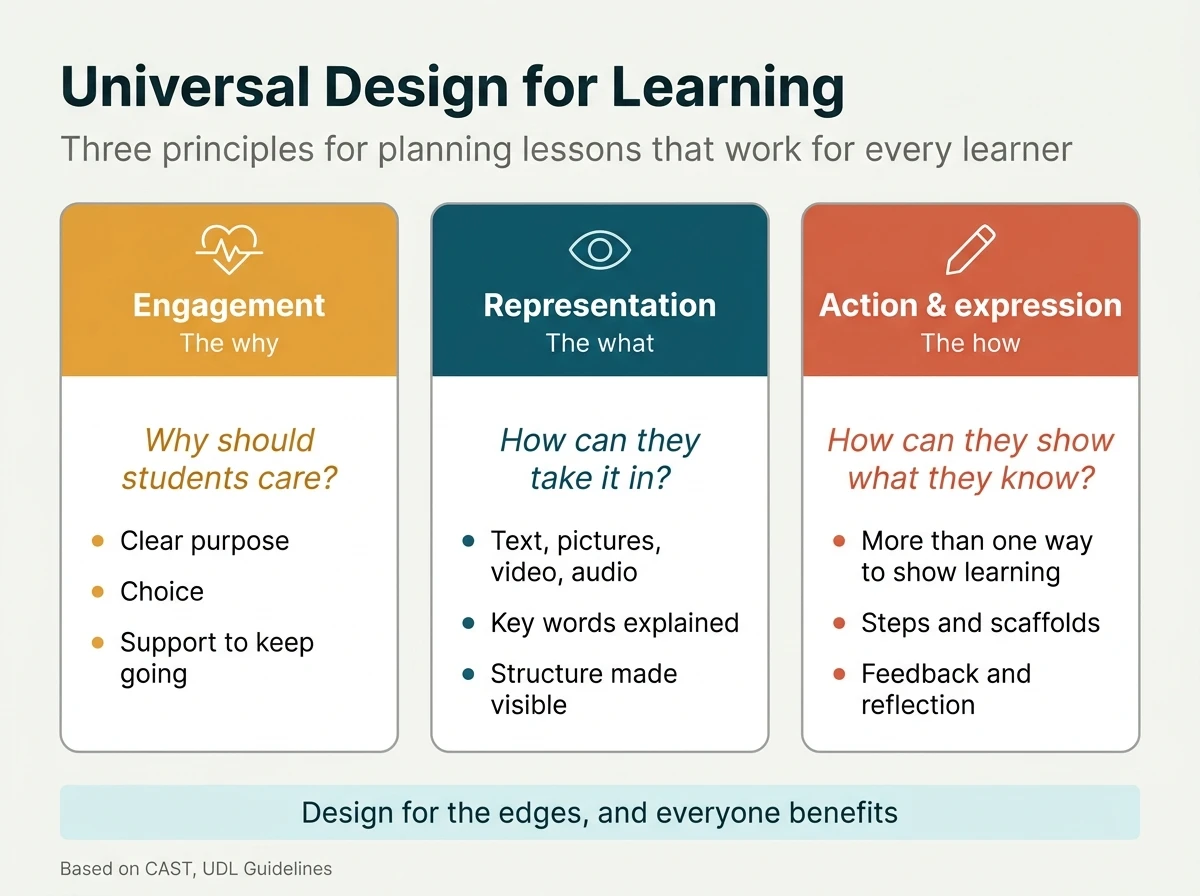
CAST's guidelines organise UDL around three principles (CAST, 2024). Each addresses a different part of learning, and each can be expressed as a single question about a lesson.
1. Engagement: the why
Learners are motivated by different things: some by working with others, some by working alone; some by immediate feedback, some by time to reflect. Engagement means giving students a reason to care, and the support to persist when work becomes difficult.
The question: does the lesson offer a clear purpose, some choice and support to keep going?
2. Representation: the what
Learners take in information differently. A dense page of text works for some and excludes others. Representation means offering the same content in more than one form, and making key terms and ideas clear. Combining words with pictures or diagrams helps most learners, not only some (Mayer, 2021).
The question: can every student access the content, whichever way they take in information best?
3. Action and expression: the how
Learners show what they know in different ways, and many need support to plan and build a piece of work. Action and expression means offering more than one route to demonstrate learning, with along the way.
The question: can students show what they understand, with the support they need to plan and build their answer?
Putting UDL into practice
UDL is not a set of additional activities. It is a way of planning. Six habits carry most of the benefit, for teachers planning lessons and for parents supporting learning at home.
- Make the goal explicitState what students are learning, and why it matters, before they begin.
- Offer more than one way inPair text with a picture, a short video or audio. Explain key words where they appear.
- Break large tasks into stepsTurn "write an essay" into named stages, with a checklist students can follow.
- Build in choiceLet students choose how they practise, who they work with or how they show understanding.
- Give feedback that moves learning onName what worked, and one clear next step.
- Build in reflectionAsk students to set small goals and review their own progress.
UDL in practice: Our Study Tribe
We designed Our Study Tribe, our Lower Secondary History platform, around these three principles.
Engagement
- Together or alone. Small, invite-only study tribes progress together; students can also study solo.
- A plan for test season. Work is broken into manageable days.
- No rankings. Progress is shared only within the tribe, so the focus stays on improvement.
Representation
- Short video lessons. A few minutes per topic, with maps and pictures on screen.
- Several formats. Captions, adjustable speed, and easy-read text that can be read aloud.
- Key words explained. A glossary sits under every video.
- Visible structure. Each argument is laid out as Point, Evidence, Elaboration, Link.
Action and expression
- Scaffolded . Think, find evidence, write, check.
- Guided writing. planning boxes for structured essays, with model answers.
- Immediate feedback. A level, a mark and what to add next: a guide to improve, not a grade.
- Practice that fits. Real exam format, timed or untimed, with flip-card review for recall.
Because school History assessments are written, most practice still ends in a written answer. We scaffold that writing closely, and continue to explore other ways for students to show their thinking.
Designing for the edges
That principle underpins everything we build at Sobena. Teachers interested in trying Our Study Tribe with a class can discuss a school pilot with us. Parents can join the free pilot at ourstudytribe.com.
References
- CAST (2024). Universal Design for Learning Guidelines version 3.0. Link
- Almeqdad, Q. I., Alodat, A. M., Alquraan, M. F., Mohaidat, M. A., & Al-Makhzoomy, A. K. (2023). The effectiveness of universal design for learning: A systematic review of the literature and meta-analysis. Cogent Education, 10(1). Link
- Mayer, R. E. (2021). Multimedia Learning (3rd ed.). Cambridge University Press.
Try Our Study Tribe
Short video lessons and step-by-step exam practice for Lower Secondary History. The free pilot is open now.
Join the free pilot