It's not a student problem. It's a design problem.
When a capable student struggles, we usually look at the student. We think we should look first at how the learning was designed.
Students bring different strengths, different patterns of attention and different ways of getting stuck. The move to secondary school makes this visible: History, Geography and Literature arrive together, each with substantial new content, and the task shifts from learning a few subjects well to managing many.
What families and teachers often observe in those first months is not a lack of ability, but overload: long passages that are hard to stay focused on, and no clear signal of what matters most. Research on explains why: is limited, and material that demands too much of it at once leaves little capacity for learning (Sweller, 1988).
Design for variation
Sobena's founder spent more than two decades designing systems at a global energy and chemicals company, from chemical plants to supply chains to sustainability strategy. The first rule of that work is never to design for one perfect input. Feedstocks vary. Demand varies. Weather varies. A well-designed system anticipates this, and still performs.
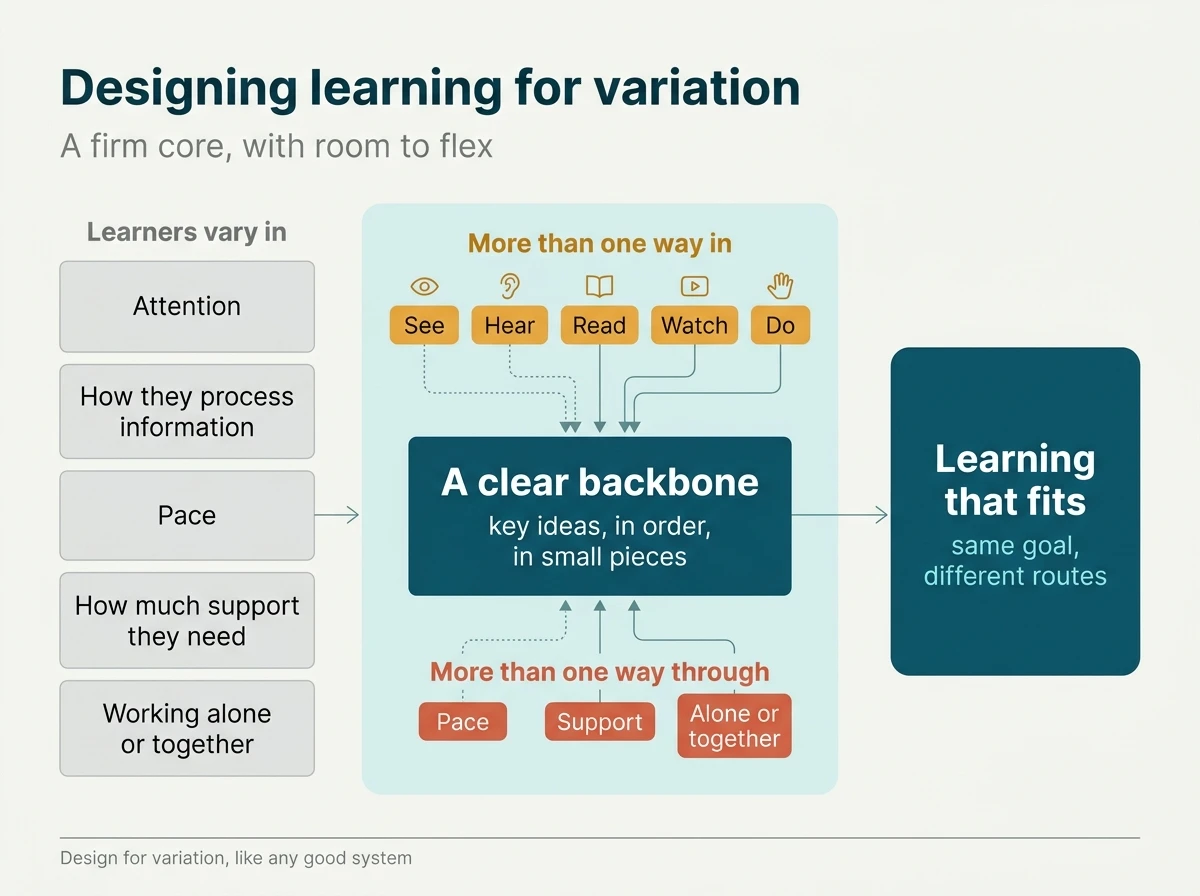
Learning is no different. Students vary in how they focus, how they process information and how much they can hold in mind at once. These differences are not flaws. They are different ways of thinking.
What good design looks like for learning
If learning were designed for variation from the start, three elements would matter most: a clear backbone, more than one way in and more than one way through. The first is a firm core; the other two give room to flex around it.
1. A clear backbone
Students need to know what matters, in what order, in pieces small enough to hold. A firm structure is what makes flexibility safe: once the key ideas are fixed, students can reach them by different routes. Breaking material into short segments reliably improves learning (Rey et al., 2019).
Consider a typical Secondary 1 History question: why did Singapore become a trading port? On a dense page, the answer is buried. Laid out as one argument, it becomes four short steps:
- PointSingapore was a natural stopover.
- EvidenceOpposite monsoon winds met near Singapore.
- ElaborationTraders waited for the winds to change, and spent and traded locally.
- LinkThe monsoons turned a shipping lane into steady local wealth.
The content is unchanged. It is far easier to hold, and it mirrors the structure of a strong exam answer.
2. More than one way in
A long block of text asks every student to take in information the same way, for the same length of time. The same idea can be presented in several forms.
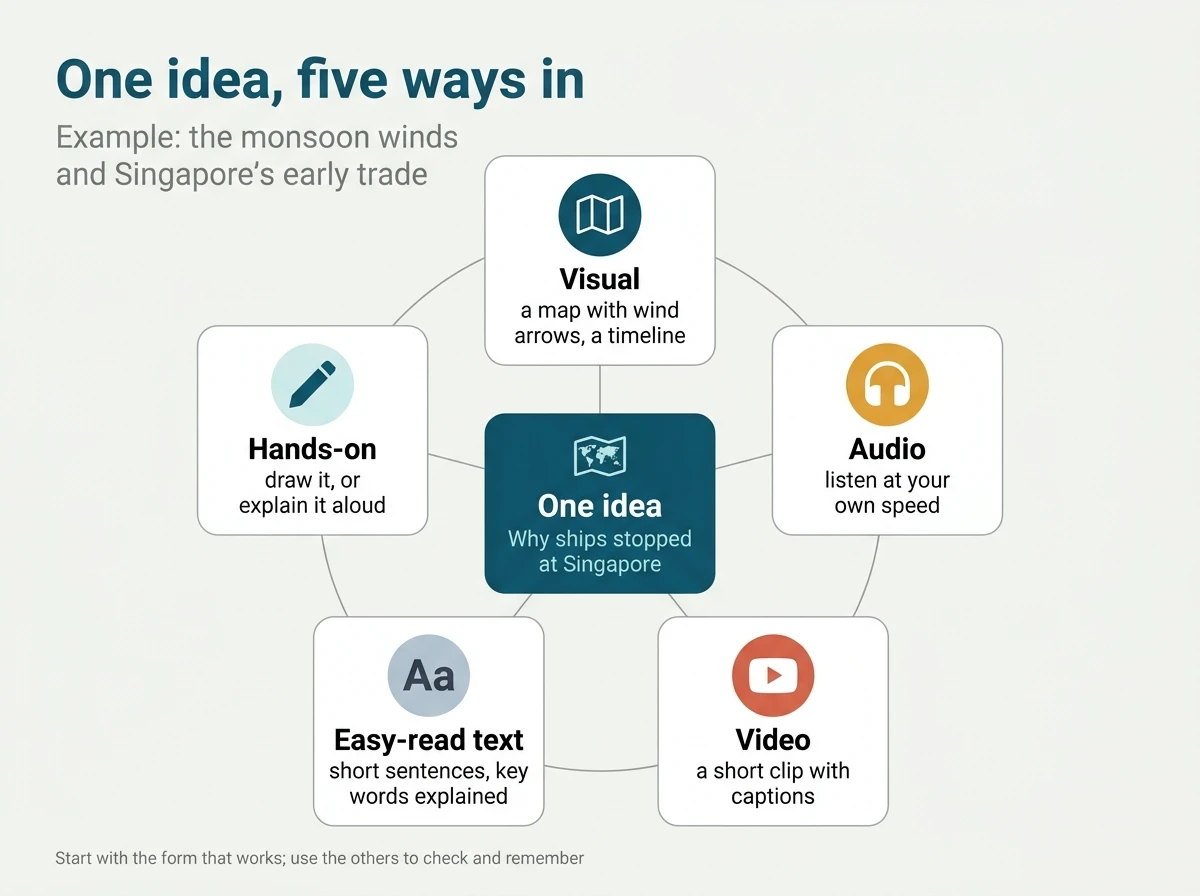
Presenting an idea in more than one form, such as words alongside a map or diagram, helps most learners (Mayer, 2021). This is not the same as matching teaching to fixed "learning styles", an idea research has not supported (Pashler et al., 2008). The point is to offer several forms to everyone, so that each student has more than one way to reach the idea and to check their understanding.
Educators call this designing for ; many families know it as . Either way, more than one way in benefits every student, not only a few.
3. More than one way through
Students differ in pace, in how much support they need, and in whether they work best alone or with others. Good design lets them choose:
- step-by-step help, or a direct attempt;
- timed or untimed practice;
- a small study group, or working solo.
Some students fall behind quietly when they study alone; others focus best on their own. The aim is a route that fits, so that no one struggles unnoticed.
Better use of screens, not more screen time
Many adults now learn at work through short online courses: brief videos, clear structure, one piece at a time. The same principles can serve young learners.
Four things families can try this week
None of this requires a new tool.
- Identify what matters mostBefore a test, agree the three or four big ideas in a chapter. Everything else hangs off those.
- Break it into piecesTurn one long page into short questions: what happened, why, and why it matters.
- Try a different way inAlongside reading, try listening, drawing a timeline or explaining it aloud.
- Find the setting that worksSome children start more easily with a study partner; others focus better alone, with a check-in.
Why Sobena exists
This is the idea behind Sobena. Our mission:
Sobena removes the barriers that hold learners back. We build affordable, thoughtfully designed learning tools for every student, however they learn and however their mind works. And we make life easier for the parents and educators who support them.
We call our approach cognitive diversity by design: learning that plans for different ways of thinking from the start, rather than patching them in later.
Our first product, Our Study Tribe, applies this to Lower Secondary History, with short video lessons, step-by-step exam practice and small study tribes. Families with a child in Lower Secondary, or about to begin, can join the free pilot at ourstudytribe.com.
References
- Sweller, J. (1988). Cognitive load during problem solving: Effects on learning. Cognitive Science, 12(2), 257–285.
- Rey, G. D., Beege, M., Nebel, S., Wirzberger, M., Schmitt, T. H., & Schneider, S. (2019). A meta-analysis of the segmenting effect. Educational Psychology Review, 31, 389–419. Link
- Mayer, R. E. (2021). Multimedia Learning (3rd ed.). Cambridge University Press.
- Pashler, H., McDaniel, M., Rohrer, D., & Bjork, R. (2008). Learning styles: Concepts and evidence. Psychological Science in the Public Interest, 9(3), 105–119.
Try Our Study Tribe
Short video lessons and step-by-step exam practice for Lower Secondary History. The free pilot is open now.
Join the free pilot