The Secondary 1 transition: why capable students struggle, and what helps
The move from Primary 6 to Secondary 1 is among the most significant transitions in a child's education. It arrives only weeks after the PSLE, and it changes almost everything at once.
It is common for students who did well in primary school to find their first months of secondary school difficult. This is often misread.
What changes in Secondary 1
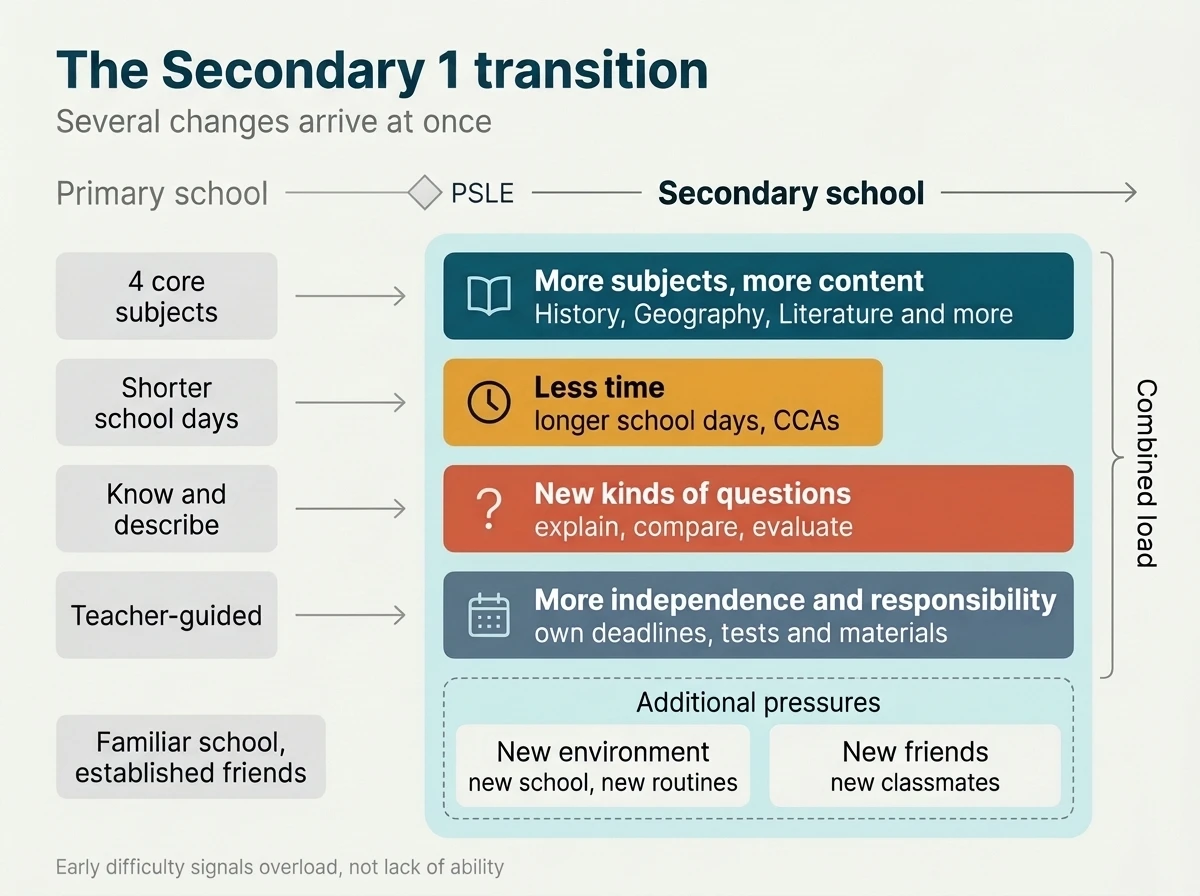
In the classroom
- More subjects, more content. From four PSLE subjects to a much broader timetable. History, Geography and Literature usually start together, each with its own vocabulary and way of writing.
- Less time. Longer school days and CCAs leave fewer hours at home to review and rest.
- New kinds of questions. Students must explain, compare and evaluate, often using sources as evidence, rather than recall facts.
- More independence and responsibility. Students manage their own deadlines, tests and materials, with fewer reminders than before.
Outside the classroom
- A new environment. A new school, new teachers and new routines to learn.
- New friendships. Most students start again socially, and that takes energy too.
Any one of these changes would be manageable on its own. Together, they arrive at the very point when routines are least established.
Research on school transitions supports this picture. A large UK study found that most children made a positive transition, but a noticeable minority did not. Settling-in support and friendships helped; worries about ability, new teachers and making friends were linked to a poorer transition (Evangelou et al., 2008).
The shape of the first year
The difficulty is not evenly spread. The first year tends to follow a recognisable pattern, with a dip in the first term.
- Nov – DecThe long breakRest after the PSLE. The best time to talk about what will be different.
- JanuaryThe first weeksOrientation, a new timetable, CCA trials. Tiredness is common; sleep matters more than extra study.
- Feb – MarThe first assessmentsResults are often lower than students are used to. This is when confidence typically dips.
- Term 2 onwardsFinding a rhythmStudents learn what each subject expects, and Term 1 habits begin to pay off.
Overload or ability: reading the signs correctly
The distinction matters, because each calls for a different response. Overload commonly shows up in four ways:
These signal that the work needs more structure, not that the student lacks ability: too much new material at once overwhelms (Sweller, 1988). Misreading them has a real cost: a student who decides early that they are not good at a subject can carry that belief for years.
Where there are concerns about a child's wellbeing or learning, the form teacher is the right first point of contact.
What helps
The common thread is structure: making the demands visible, and breaking them into manageable parts.
- Make the week visibleOne weekly plan with tests, deadlines and CCAs removes avoidable surprises.
- Identify the key ideas firstAgree the three or four ideas that matter in each topic. Detail sticks better to a framework.
- Teach the question typesPractise the structure of a strong answer, such as Point, Evidence, Elaboration, Link, before tests.
- Favour short, regular reviewFifteen to twenty minutes on most days beats a long session the night before. and self-testing are among the most effective study techniques (Dunlosky et al., 2013).
- Offer more than one way inPair text with diagrams, maps or explaining aloud. Combining forms helps most learners (Mayer, 2021).
- Reduce isolationA study partner, a small group or regular check-ins, whichever suits the child, brings difficulty to light early.
A transition that can be designed for
The Secondary 1 transition is often treated as a test of individual resilience. We see it differently.
With structure, patience and a clear message that early difficulty is part of learning something new, most students find their footing.
Our Study Tribe was designed for this transition, beginning with Lower Secondary History. Families with a child in Lower Secondary, or about to begin, can join the free pilot at ourstudytribe.com.
References
- Evangelou, M., Taggart, B., Sylva, K., Melhuish, E., Sammons, P., & Siraj-Blatchford, I. (2008). What makes a successful transition from primary to secondary school? Department for Children, Schools and Families, Research Report DCSF-RR019. Link
- Sweller, J. (1988). Cognitive load during problem solving: Effects on learning. Cognitive Science, 12(2), 257–285.
- Dunlosky, J., Rawson, K. A., Marsh, E. J., Nathan, M. J., & Willingham, D. T. (2013). Improving students' learning with effective learning techniques. Psychological Science in the Public Interest, 14(1), 4–58. Link
- Mayer, R. E. (2021). Multimedia Learning (3rd ed.). Cambridge University Press.
Try Our Study Tribe
Short video lessons and step-by-step exam practice for Lower Secondary History. The free pilot is open now.
Join the free pilot