Design principles
How we design learning, and the research behind it
Every Sobena tool is built on a small set of principles drawn from the learning sciences. This page sets out what those principles are, how they show up in our tools, what we deliberately avoid, and the research we draw on.

Our starting point
Why we design this way
Every student learns differently.Attention, , processing speed and prior knowledge vary between students, and shift with the task and the day. Research calls this ; many families know part of it as .
So we design for variation from the start.Most materials are built for an imagined average student, with accommodations added later. We do the reverse, because what is essential for some learners helps every learner. It is a rule borrowed from systems design: never design for a single, ideal input.
It matters most at the start of secondary school.This is a sensitive period for motivation (Eccles et al., 1993), just as History asks students to weigh sources and argue in writing. When the format adds needless load, capable students can mistake overload for inability. We treat that as a design problem, not a student problem.
Our principles
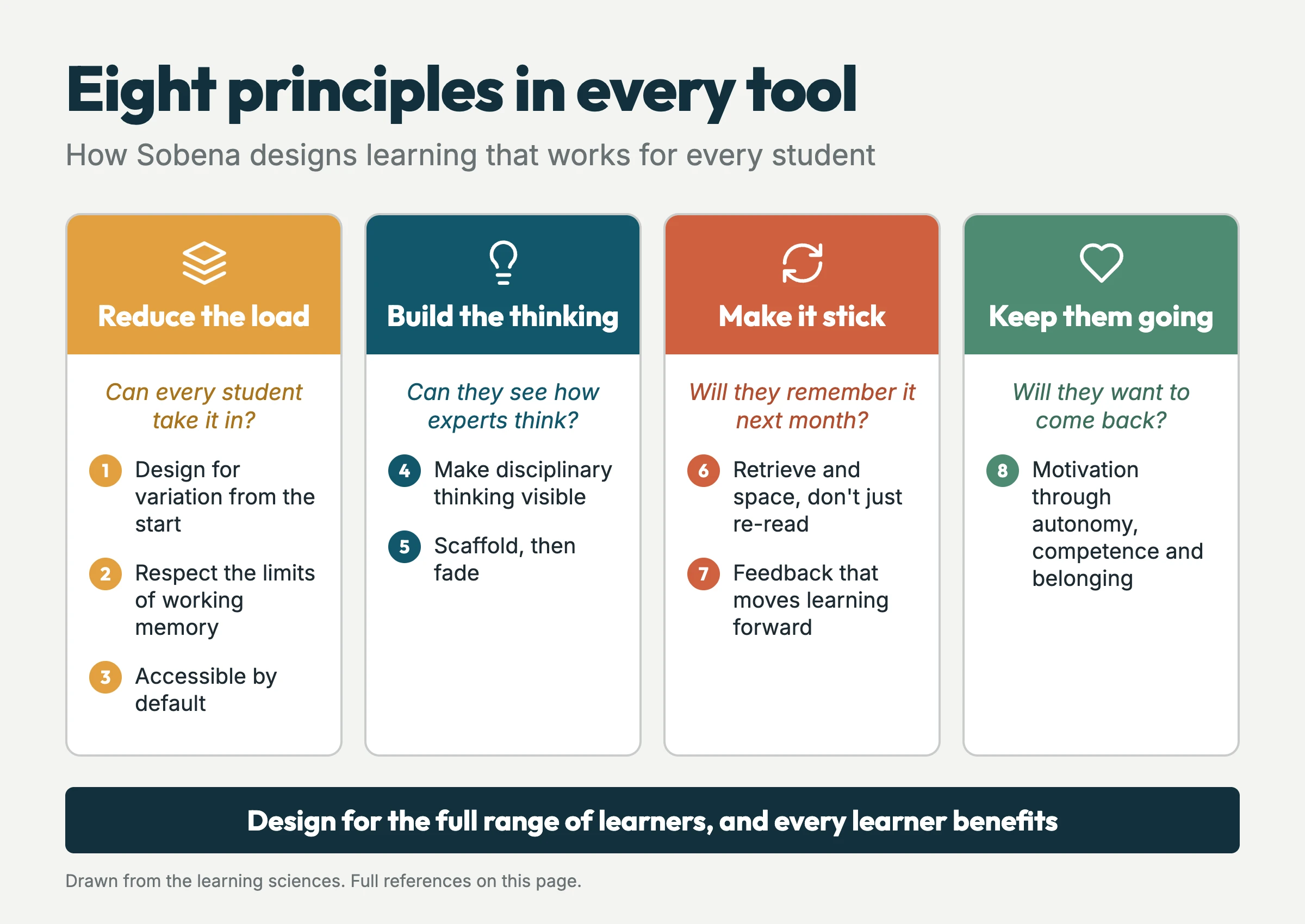
Eight principles in every tool
Each principle names what we do, how it appears in our tools, and the research it draws on.
Reduce the load
Design for variation from the start
Plan for the full range of learners from the outset, not for an imagined average.
Students differ in attention, working memory, processing speed and prior knowledge, and those differences shift with the task and the day.
In our tools
- Every lesson can be watched, heard or read
- Accessibility built in, not bolted on
Research basis: Universal Design for Learning (CAST, 2024)
Respect the limits of working memory
Present one idea at a time, so students spend their effort understanding, not organising.
Working memory holds only a little at once. Long, unstructured text uses it up; sequencing and segmenting content frees it for thinking.
In our tools
- Lessons of a few minutes, one idea each
- Words, visuals and narration designed to work together
Research basis: Cognitive load theory (Sweller, 1988); multimedia learning (Mayer, 2021)
Accessible by default
Build in what some learners need, because it helps every learner.
Captions, adjustable text and audio alongside text are essential for some students and useful for all. They are core design, not special settings.
In our tools
- Captions, adjustable playback speed and a glossary
- An immersive reader with read aloud, line focus and an easy-read font
- Try it on this site with the Listen and Aa buttons
Research basis: Universal Design for Learning (CAST, 2024)
Build the thinking
Make disciplinary thinking visible
Model expert reasoning step by step, and name its parts.
History is a way of reasoning with evidence, not only a body of facts. That reasoning stays invisible to novices until it is shown.
In our tools
- Arguments laid out as Point, Evidence, Elaboration and Link
- Source questions broken into named skills, such as inference and comparison
- Questions tagged with the they practise, which students can tap to learn about
Research basis: Historical thinking concepts (Seixas & Morton, 2013)
Scaffold, then fade
Give structured support early, then withdraw it as students grow independent.
Support helps learners succeed at tasks just beyond what they can do alone. The goal is independence.
In our tools
- Guided boxes, sentence starters and step-by-step hints
- After consistently strong answers, students are invited to try without them
- Full practice papers in the assessed format
Research basis: Scaffolding (Wood, Bruner & Ross, 1976)
Make it stick
Retrieve and space, don't just re-read
Practise recalling, spread over time: it strengthens memory far more than re-reading.
Practice testing and spaced study are among the most effective study techniques; re-reading and highlighting are among the least.
In our tools
- Quick checks pause the video so students answer first
- A daily review brings ideas back after 1, 2, 4, 7, 14 and 30 days, ending with an "explain it in your own words" card
- Chapter quizzes mix questions from different lessons
Research basis: Test-enhanced learning (Roediger & Karpicke, 2006); effective learning techniques (Dunlosky et al., 2013)
Feedback that moves learning forward
Tell students where they are going, how they are doing and what to do next.
A score alone rarely changes what a student does on the next attempt. A specific next step does.
In our tools
- The marking ladder is visible before students write
- Every answer gets an indicative level, one strength and one next step
- Students can track their levels over time
Research basis: Assessment for learning (Black & Wiliam, 1998); the power of feedback (Hattie & Timperley, 2007)
Keep them going
Motivation through autonomy, competence and belonging
Sustain effort through choice, visible progress and connection, not pressure.
Young people keep going when they feel some control, see their progress and feel connected. Public comparison tends to undermine that, especially for students already struggling.
In our tools
- Daily goals with a short reflection
- Progress counted as days studied each week, not streaks
- Small invite-only study tribes with no public rankings
Research basis: Self-determination theory (Ryan & Deci, 2000)
What we avoid
Choices we make on purpose
Good design is also about what you leave out. Four popular approaches we deliberately avoid, and what we do instead.
- We avoidSorting students by “learning style”InsteadSeveral ways in for every student
Matching teaching to a preferred style, such as visual or auditory, is not supported by the evidence. (Pashler et al., 2008)
- We avoidPublic rankings and leaderboardsInsteadEach student's own progress
Comparison with peers motivates a few students and discourages many.
- We avoidStreaks that punish a missed dayInsteadDays studied each week
A busy or unwell day shouldn't feel like failure. Progress always adds up and never resets to zero.
- We avoidOpen-ended screen timeInsteadShort sessions with a clear end
A lesson should leave a student finished, not scrolling.
From principle to evidence
How we test our design
Drawing on research is not the same as proving impact. Research tells us what tends to work; it cannot tell us how well a particular tool works for Singapore students, in Singapore classrooms and homes.
Our pilots are structured to find out. With partner schools and families, we look at how students actually use our tools, where they support learning, and where the design needs to change. Usage is captured in aggregate, no individual student or school is identified, and what we learn shapes what we build next.
References
The research we draw on
The principal works that inform our design, listed alphabetically.
Black, P., & Wiliam, D. (1998). Inside the black box: Raising standards through classroom assessment. Phi Delta Kappan, 80(2), 139–148.
Assessment for learning: using assessment information to guide the next step in learning.
CAST (2024). Universal Design for Learning Guidelines, version 3.0.
Designing for learner variability through multiple means of engagement, representation and expression.
Dunlosky, J., et al. (2013). Improving students' learning with effective learning techniques. Psychological Science in the Public Interest, 14(1), 4–58.
Why practice testing and spaced practice outperform re-reading and highlighting.
Eccles, J. S., et al. (1993). Development during adolescence: The impact of stage–environment fit. American Psychologist, 48(2), 90–101.
Why the transition into secondary school is a sensitive period for motivation and attainment.
Hattie, J., & Timperley, H. (2007). The power of feedback. Review of Educational Research, 77(1), 81–112.
Feedback that answers “Where am I going? How am I going? Where to next?”
Mayer, R. E. (2021). Multimedia Learning (3rd ed.). Cambridge University Press.
Principles for combining words, visuals and audio, including segmenting and signalling.
Pashler, H., McDaniel, M., Rohrer, D., & Bjork, R. (2008). Learning styles: Concepts and evidence. Psychological Science in the Public Interest, 9(3), 105–119.
Why we offer multiple representations to everyone, rather than matching students to a single style.
Roediger, H. L., & Karpicke, J. D. (2006). Test-enhanced learning. Psychological Science, 17(3), 249–255.
Retrieval practice as a tool for durable learning, not only for assessment.
Ryan, R. M., & Deci, E. L. (2000). Self-determination theory and the facilitation of intrinsic motivation. American Psychologist, 55(1), 68–78.
Autonomy, competence and relatedness as foundations for sustained motivation.
Seixas, P., & Morton, T. (2013). The Big Six Historical Thinking Concepts. Nelson Education.
Treating historical understanding as disciplinary thinking, including the use of evidence.
Sweller, J. (1988). Cognitive load during problem solving: Effects on learning. Cognitive Science, 12(2), 257–285.
Why content is sequenced and segmented to respect the limits of working memory.
Wood, D., Bruner, J. S., & Ross, G. (1976). The role of tutoring in problem solving. Journal of Child Psychology and Psychiatry, 17(2), 89–100.
Scaffolding: structured support that is gradually withdrawn as competence grows.