Better use of screens, not more screen time
Concern about children's screen time is widespread, and much of it is justified. But the debate often focuses too narrowly on hours. The more useful question is what the screen is asking of a child.
In Singapore, the Ministry of Health updated its guidance on screen use for children aged up to 12 in January 2025, recommending limits on recreational screen time and screen-free routines such as mealtimes (Ministry of Health, 2025). Families of older children face the same questions.
Twenty minutes working through a short lesson and a few practice questions is very different from twenty minutes on a feed that never ends. Both happen on a screen. Only one leaves a child having learned something, and able to stop.
Passive scrolling versus purposeful learning
Purposeful screen time tends to share five characteristics.
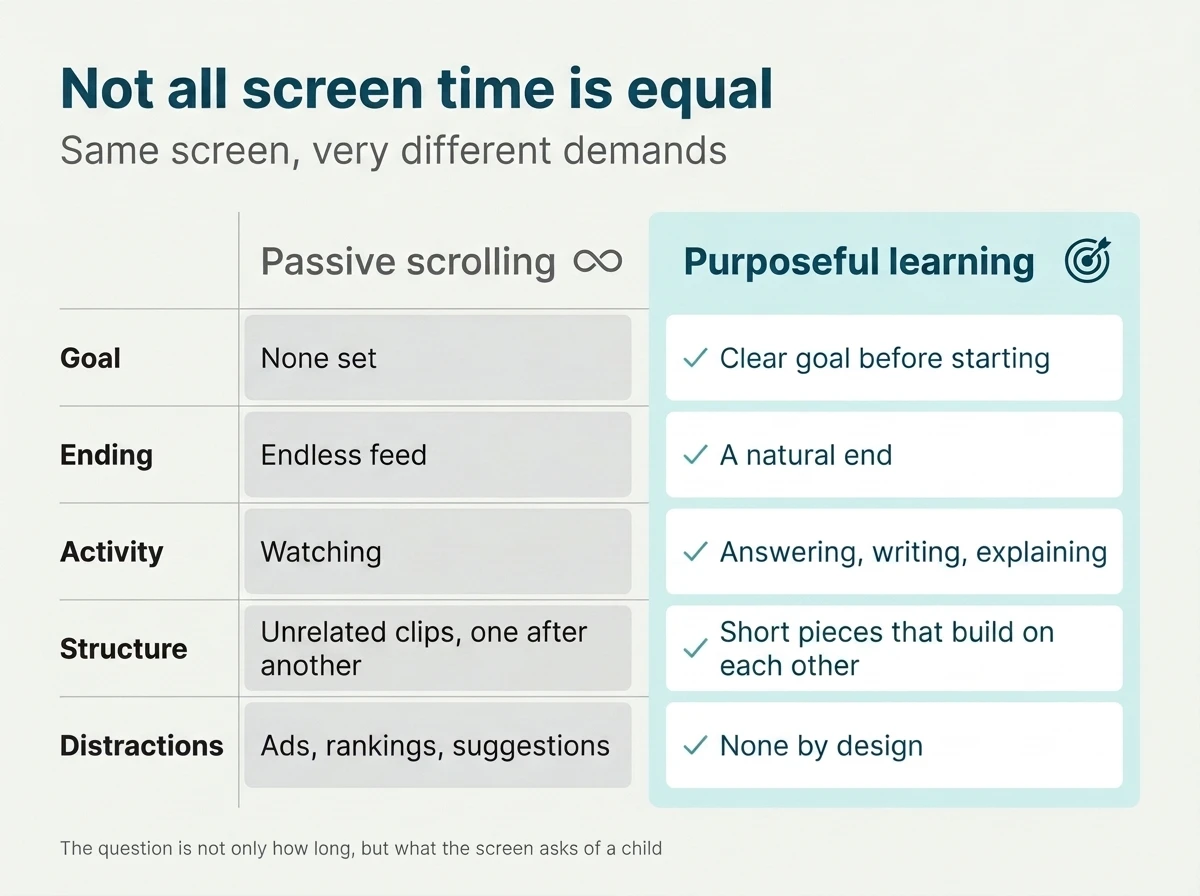
- A clear goalThe student knows what they are trying to learn or finish before they start.
- A natural endThe lesson finishes, rather than rolling straight into the next thing.
- Active workThe student answers, writes, sorts or explains, rather than only watching.
- Pieces that buildShort-form video is short too. The difference is that each piece builds on the last towards a goal, rather than jumping between unrelated clips.
- Nothing pulling them awayNo ads, endless suggestions or rankings designed to drive return visits.
What to look for in a learning app
Four questions help separate tools designed for learning from tools designed for attention.
How we design for it at Sobena
Our tools follow these principles: short lessons with one idea at a time, practice that asks students to think and write, goals students set themselves, and no ads or rankings.
Simple routines at home
- Agree when and where. For example, at the dining table after dinner.
- Start with one goal. "Finish this lesson and the quiz."
- Ask them to teach you. Afterwards, have your child explain one thing they learned. Recalling and explaining strengthens memory (Roediger & Karpicke, 2006; Dunlosky et al., 2013).
- Keep learning and free time separate. Each has its own place.
Screens will remain part of children's lives. The task is to make the time they spend on them count. Our Study Tribe's free pilot for Lower Secondary History is open at ourstudytribe.com.
References
- Ministry of Health, Singapore (2025). Guidance on screen use in children (updated January 2025). Link
- Roediger, H. L., & Karpicke, J. D. (2006). Test-enhanced learning: Taking memory tests improves long-term retention. Psychological Science, 17(3), 249–255.
- Dunlosky, J., Rawson, K. A., Marsh, E. J., Nathan, M. J., & Willingham, D. T. (2013). Improving students' learning with effective learning techniques. Psychological Science in the Public Interest, 14(1), 4–58. Link
Try Our Study Tribe
Short video lessons and step-by-step exam practice for Lower Secondary History. The free pilot is open now.
Join the free pilot